“Eat 30 different plants a week” is everywhere at the moment. Here’s where the number comes from, what the study behind it found, what it doesn’t show, and why wild plants count too.

I’m Bex Northman, a forager and Member of the Association of Foragers. I teach people to identify wild edible plants in woodland and on the coast across Cumbria, Northumberland and the Scottish Borders. So when “30 plants a week” took off, I wanted to know two things: where the number came from, and whether the plants I pick count. I went back to the original research. This is what I found, including the parts that often get left out.
Where does “30 plants a week” come from?
It comes from the American Gut Project, a citizen-science study run from the University of California San Diego. Volunteers, mostly in the US and the UK, sent in a stool sample and answered questions about their diet and lifestyle. By 2017, more than 11,000 people had taken part, and the researchers published their first big results in 2018.
One of the survey questions was simple: “In an average week, how many different plants do you eat?” The researchers compared the people who answered “more than 30” with those who answered “fewer than 10”. The 30-plus group had a more varied mix of gut bacteria.
They noticed something else too. The number of different plants people ate was linked to that variety more closely than whether they called themselves vegan or omnivore.
That’s where 30 comes from. It was the top answer on the questionnaire, not a target the researchers set.
What the study doesn’t show
This is the part that tends to get lost:
- The headline comparison was small. Over 11,000 people took part in the project, but the detailed “more than 30 against fewer than 10” comparison was about 85 people, roughly 40 in each group.
- People estimated their own numbers. It was one question, answered from memory, and a plant counted the same whether it was a bowl of lentils or a sprinkle of parsley.
- The volunteers weren’t typical. The researchers themselves point out that they were better educated, better off and less likely to smoke than most people, and they urge caution about applying the results to everyone.
- It was a snapshot, not an experiment. Nobody was asked to change what they ate, so it can’t show that eating more plants caused the difference.
- It didn’t measure health. It looked at bacteria, not at whether anyone was healthier.
- 30 isn’t a magic number. The project’s own website calls it “a guideline, not a rigid threshold”.
None of that makes the finding wrong. It’s an interesting pattern from a big project. But it’s a pattern, not proof, and a lot of what’s written about 30 plants a week goes further than the study did.
What counts towards 30 plants a week?
In the original question, every different plant counted. A soup with carrot, potato and onion was three plants. Each grain in a multigrain loaf counted separately, and so did every kind of fruit.
Do herbs count? The original question didn’t mention herbs or spices. Some popular versions of the challenge count them as a quarter of a plant each.
Do wild plants count? Yes. The survey didn’t ask where your plants came from: a blackberry is a blackberry, whether it came from a punnet or a hedge. What foraging adds is plants you’ll never see on a supermarket shelf at all. A handful of crops fills most of those shelves, while our hedgerows, woods and shores hold far more. I’ve written more about that here.
What can hunter-gatherers tell us?
Some of the most interesting research comes from the Hadza, hunter-gatherers in Tanzania who still get much of their food from the wild: tubers, berries, honey, baobab fruit and meat from hunting.
In 2017, researchers collected 350 stool samples from 188 Hadza people over about a year. Their gut bacteria changed with the seasons as their food changed. Some groups of bacteria disappeared in one season and came back in another. The groups that came and went turned out to be the same ones that differ most between traditional and industrialised populations around the world.
A 2023 follow-up sequenced Hadza samples in far more detail. It found that the Hadza have a more varied mix of gut bacteria than the people in Nepal and California they were compared with. It also identified 124 gut species that have become rare in industrialised populations.
What it doesn’t show: the Hadza live differently from us in almost every way, not only in what they eat. So these studies can’t say which part of their life makes the difference, or what it means for anyone’s health. It’s a window on how varied a human gut can be, not a diet plan.
What about the “wild” part: soil, woods and microbes?
There’s a second strand of research, about contact with wild places rather than food. Researchers call it the biodiversity hypothesis, or the “old friends” idea. Humans evolved alongside the microbes in soil, plants and animals, and modern life, mostly indoors and in towns, means we meet far fewer of them. Researchers are studying what that might mean.
The best-known test comes from Finland. In 2016, researchers covered part of the gravel yards at four city daycare centres with forest floor, turf and planters. After 28 days, the children at those centres had kept a more varied mix of skin bacteria, while it declined in children playing in ordinary gravel yards. One group of their gut bacteria had become more varied too.
It’s a lovely study, and a small one: 75 children in all, with only 16 in the ordinary yards, over four weeks. The researchers couldn’t control for home life, and they didn’t measure whether the children were healthier. They write that proof is still lacking. A 2024 review of 82 studies in this field found results pointing in both directions, and called for longer-term research.
Plants carry microbes too. A 2023 study found bacteria typical of fruit and vegetables in human gut samples, making up around 2% of gut bacteria. People who ate a wider range of plants tended to have more of them. The study couldn’t prove the bacteria came from the food, but it’s a nice reminder that a plant arrives with its own tiny passengers.
What’s solid, and what’s still open
Fairly solid:
- What we eat shapes the bacteria in our gut, and people who eat a wider range of plants tend to have a more varied mix.
- Hunter-gatherers have a more varied mix of gut bacteria than people in industrialised countries.
- Soil, plants and wild places carry their own microbes, and some of them reach us.
Still open:
- Whether a more varied mix of gut bacteria makes any one person healthier. More varied isn’t automatically better, and researchers are still working out what “good” looks like.
- Whether 30 means anything in particular.
- Whether wild plants make any difference compared with shop-bought ones. As far as I can find, no study has looked at foraging and the gut microbiome at all.
Why it matters to me
I find this research fascinating, but I don’t forage to hit a number. What I love is that once you can recognise wild plants, variety takes care of itself. The hedge at the end of the lane changes every few weeks, and so does what ends up in the pan.
Please don’t start picking on your own
If this has made you want to add wild plants to your week, please start with someone who knows them. Several of Britain’s most poisonous plants look a lot like edible ones, and the differences can be small. Identification is a skill you learn, and it’s the one thing I’d never want anyone to guess at.
Learn to identify wild plants with me
On a half-day Foraging Walk, I’ll help you identify 15 to 20 wild edible plants in woodland or on the coast: how to recognise each one, the lookalikes to avoid, and how to pick it well. On a full day, it’s more than 30. Small groups, beginners welcome.
Hooked already? Masterclasses are full days on one subject, such as hedgerow herbs or wild mushrooms.
More questions? Read the FAQs →
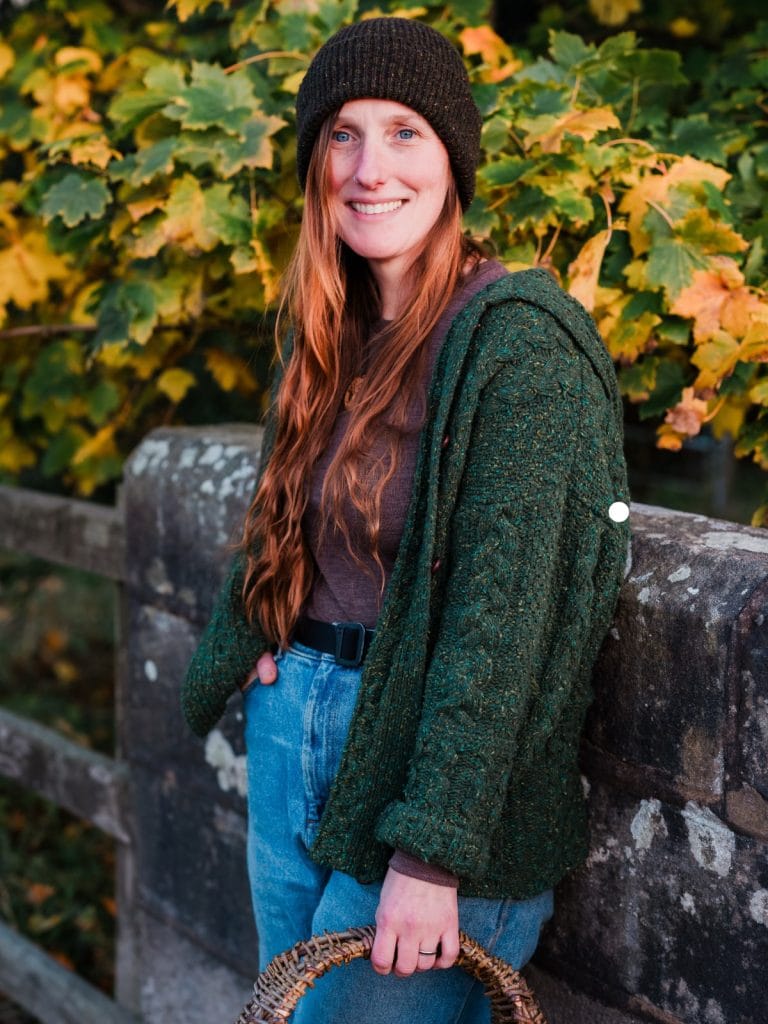
I’m Bex Northman, a Member of the Association of Foragers. I teach foraging and herbal remedy making across Cumbria, Northumberland and the Scottish Borders. More about me →
This article is for educational interest only. It describes published research and isn’t medical or dietary advice. Bex Northman is not a doctor, dietitian or medical herbalist. If you’re thinking of changing your diet, especially if you’re pregnant, taking medication or have a health condition, talk to your GP or a registered dietitian first. Never eat a wild plant unless you’re certain what it is.
Sources
- McDonald D. et al. (2018). American Gut: an Open Platform for Citizen Science Microbiome Research. mSystems 3(3). doi.org/10.1128/mSystems.00031-18
- The Microsetta Initiative (the American Gut Project today). 30 Plants Per Week. microsetta.ucsd.edu/30-plants-per-week
- Pigott A. (2025). The 30-plants-a-week challenge. The Conversation. theconversation.com
- Smits S.A. et al. (2017). Seasonal cycling in the gut microbiome of the Hadza hunter-gatherers of Tanzania. Science 357(6353). doi.org/10.1126/science.aan4834
- Carter M.M. et al. (2023). Ultra-deep sequencing of Hadza hunter-gatherers recovers vanishing gut microbes. Cell 186(14). doi.org/10.1016/j.cell.2023.05.046
- Roslund M.I. et al. (2020). Biodiversity intervention enhances immune regulation and health-associated commensal microbiota among daycare children. Science Advances 6(42). doi.org/10.1126/sciadv.aba2578
- Paciência I. et al. (2024). The role of biodiversity in the development of asthma and allergic sensitization: a state-of-the-science review. Environmental Health Perspectives 132(6). doi.org/10.1289/EHP13948
- Wicaksono W.A. et al. (2023). The edible plant microbiome: evidence for the occurrence of fruit and vegetable bacteria in the human gut. Gut Microbes 15(2). doi.org/10.1080/19490976.2023.2258565